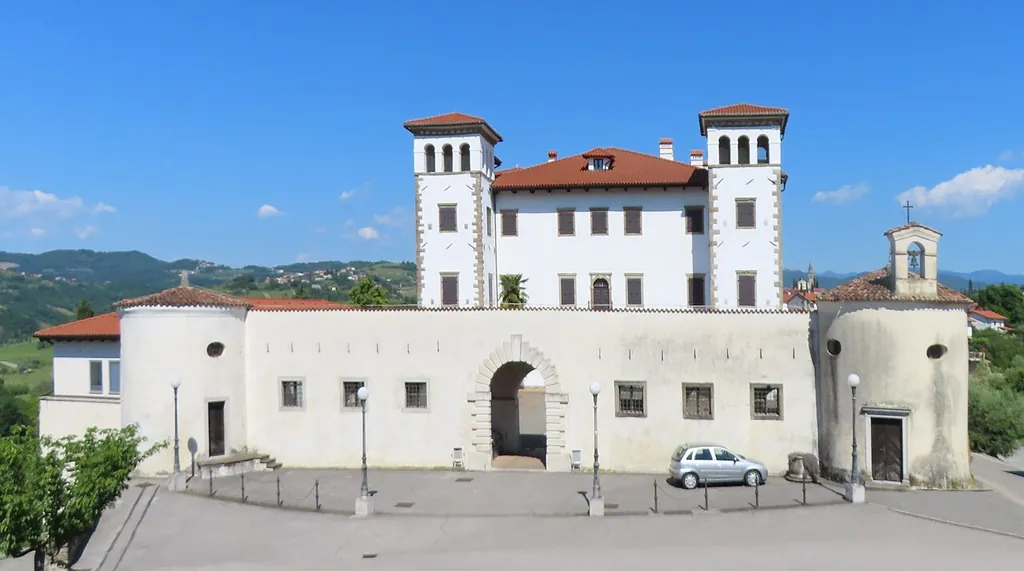
Grad Dobrovo
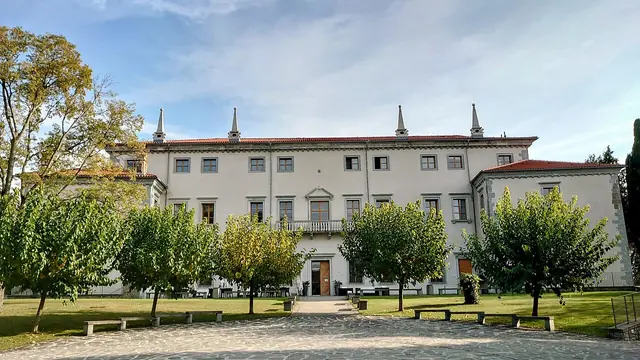
Renaissance castle in the Brda hills with the Viteška dvorana (Knights' Hall), a hunting room, the chapel of St Anthony of Padua and the Galerija Zorana Mušiča.
Have only individual sections read aloud
About the museum
A castle has stood at Dobrovo since the 13th century, but it decayed over the centuries. At the beginning of the 17th century a new Renaissance building rose on its site; it has survived to the present in a relatively unchanged form and is considered one of the most beautiful castles in the Goriška region. Its ground plan is an almost perfect square with symmetrically placed towers at the corners. The walls were probably built during the Second Venetian War (1615–1617) and, once the danger had passed, converted into an arcaded corridor.
One of the towers has been converted into a chapel dedicated to St Anthony of Padua; its walls are adorned with detached frescoes and copies of Gothic frescoes from northern Primorska. Among the owners were the Counts Colloredo, for a time the Marquis Montecuccoli, from the end of the 18th century the Catterini-Erzberg family from Gorizia, and in 1872 the estate passed by marriage to the de Baguer family. On the first floor is the Viteška dvorana with the coats of arms of noble families and a preserved painting of a naval attack on a town; in the Lovska soba (Hunting Room) there are frescoes by Clemente Del Neri from 1894, depicting the estates of Count de Baguer.
In 1974 the castle was taken over by the Goriški muzej, which renovated it between 1979 and 1991. According to a notice on the website of the Goriški muzej, the museum no longer manages the castle until further notice.
Highlights
- Renaissance castle with a square ground plan and corner towers
- Viteška dvorana (Knights' Hall) with coats of arms and a painting of a naval attack
- Hunting room with frescoes by Clemente Del Neri
- Chapel of St Anthony of Padua with Gothic frescoes
- Galerija Zorana Mušiča
Permanent exhibitions
- Galerija Zorana Mušiča – Gallery in the castle dedicated to the painter Zoran Mušič; among the collections a display of his graphic works is mentioned.
- Center za doživetje soteske Kožbanjšček – Experience of the Kožbanjšček gorge with VR glasses, light panels with maps of the Brda since the 16th century and a video projection, Zgodba o rebuli.
Admission & discounts
| Adults | €8 |
|---|---|
| Reduced | €5children (7–18 years), pensioners and students |
| Children & teens | €5free up to age 6 · Children up to and including 6 years have free admission. |
| Seniors | €5 |
| Students & apprentices | €5 |
| Groups (16+ people) | €6 per personAdult groups of more than 15 people; school groups (primary and secondary schools) €4 per person. |
| Families | €15Three-member family; families with four or more members €20. |
| Combined ticket (Grad Dobrovo, Vila Vipolže, Briška hiša and the cellar in Šmartno): adults | €10 |
| Combined ticket: children (7–18 years), pensioners, students | €6 |
| Combined ticket: school groups | €5 |
| Combined ticket: adult groups of more than 15 people | €8 |
| Combined ticket: three-member family | €20 |
| Combined ticket: family with four or more members | €25 |
The price list applies to visiting the castle; the same age limits apply to the combined ticket.
Accessibility
The museum hasn’t published any information on this.
Kids & families
The museum hasn’t published any information on this.
Getting there & parking
The museum hasn’t published any information on this.
Amenities & dining
The museum hasn’t published any information on this.
Events & venue rental
The museum hasn’t published any information on this.
Plan your visit
| Good to know | The Goriški muzej no longer manages the castle until further notice. Before a visit, please check whether the collections are open again. |
|---|